Back to top: Dotted eye
Introduction: Stylistic characteristics
One of the main characteristics of this style is the way in which the heads and bodies of both humans and animals are depicted.
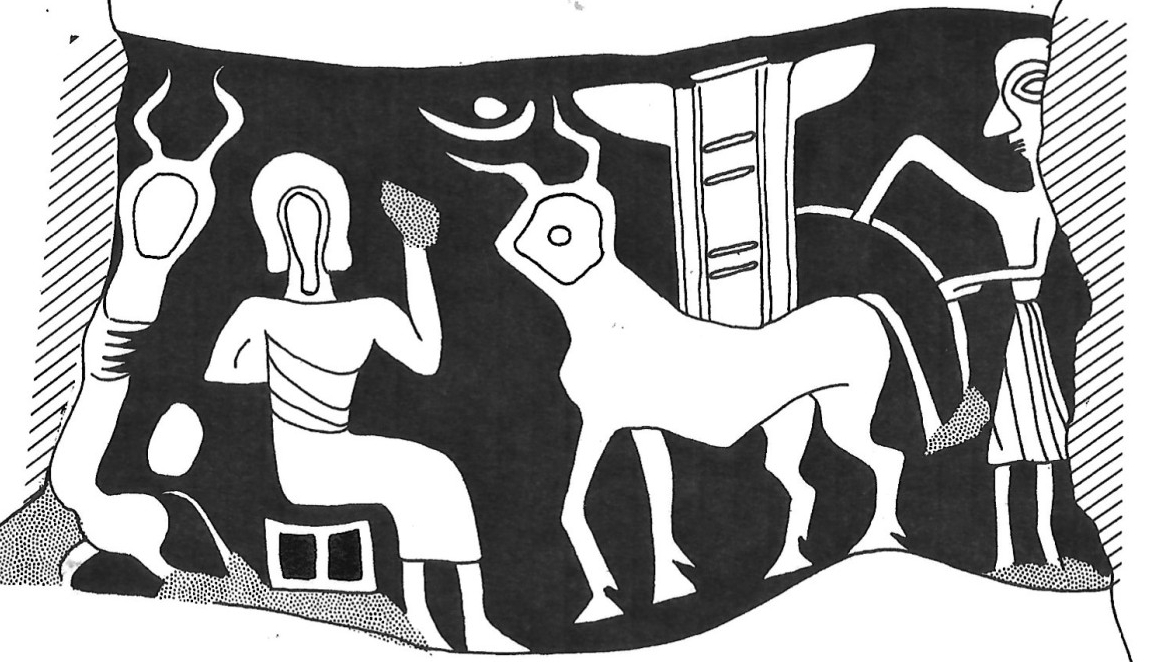
All the human figures, as well as the animals, have full bodies, often with relatively wide spaces between the figures. The human torsos can be triangular in shape but the triangles are full and attached to other parts of the human body so that the triangle is not emphasized, see for example A6.103 and A5.137.
In the A6.103 example the triangles are emphasized but the figures are overlapping as the human standing in front of the bull. Otherwise, in this style the figures are for the most part not overlapping but are placed with space between them (as in A5.137).
The figures can sometimes have a size mixture, depicting large and small figures in the same composition. In the example A6.103 there are different figure sizes as in the two small animals above the larger figures. This and overlapping figures are rare in this style so that neither of these aspects is characteristic for the Dotted Eye Style but shows the variation that can be found in it.
|
 A6.103
 A5.137
|
Back to top: Dotted eye
In this style the human head is large and shaped as a circle or an oval; in some cases a singular circular line with a raised dot in or near the center. In other examples more than one line depicts the eye and is extended to attach the nose and sometines even the mouth. The nose can be triangular in shape. The figures usually have small lips and chin which can be pointed.
Only a single eye is depicted in the center of the head. The eye is large and prominent and usually dotted in the center with a large heavy dot. The effect is a wide depression around the interior of the head. The eye is depicted in a front view although the head is almost always in profile. The artists must have observed the human profile and noted that in that view only one eye is apparent and chose to prominently display only one eye. Part of the uniqueness of the style is the visual impact of this eye and the artists and their patrons must have thought that this part of the human face was the most important.
The linear aspect of the head is further illustrated by straight legs and arms as well as in the way the garments are depicted with strong linear patterns.
| A good example is A5.137 the animal carrying the winged gate on its back shows these characteristics; the human figure behind this animal exemplifies the head and body characteristics (for example the huge head, triangular body and very straight thin legs) of this style. Sometimes however animals can have slightly bent knees as we see in the standing bull.
|
| 
|
Back to top: Dotted eye
Animal depictions in this style have similar characterists as the humans. See for instance A6.147 INSERT W11d0607 where the eye is a wide oval with the large dot in the center. A line connects this eye with the nose and mouth. The two horns are shown in front view while the head is in profile. The horns are full and emphasized with sweeping lines. All these characteristics highlight the linear pattern of the design.
A seal impression seen above A5.137 here the bull head is in profile with a dotted eye in the center but this eye has an iregular circlar shape. The animal horns are segmented and the hoofs are shown in sharp points. The other horned animal has this same type of horns but the head is probably in front view which signals a bearded bull although this is not clear from the sealing. The standing bull shows a contrast between the full body and the thin lines for the legs, especially the front legs.
The eye of the standing human figure has an oval eye but the seated figure and the bull behind are both extended ovals. In this seal impression the two human heads are a thicker line, especially at the top. The large triangular nose of the servant is connected by a line with the area of the eye. The legs are long thin lines.
Interestingly the crescent with a dot above can be seen also in the Deep Fringe style.
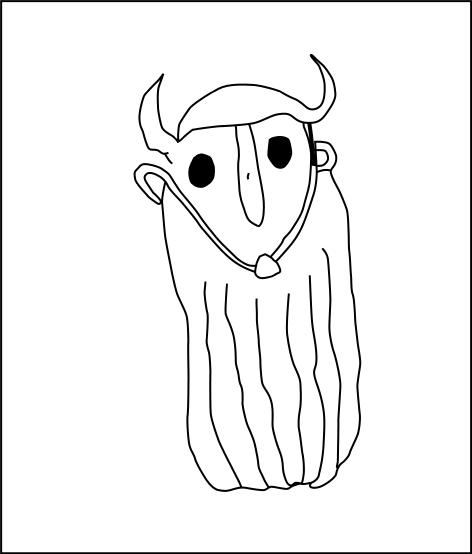
Interestingly in Alq975.18 INSERT (W10d06/W10d0605) the head of the bearded bull is shown in front view making it necessary to depict the two eyes smaller than is usual in this style. This head is created with a small drill hole for each eye and one at the base of the chin; the exterior shape of the fontally positioned face is in a raised outline with the rest of the face in an undifferentiated flat plane. In Urkesh animal combat scenes usually portray bearded bulls with the face in front view but the face usually has more details.
[below to drill hole variant?].
|
|  Alq975.18
|
|
|
| |
Back to top: Dotted eye